

by Beatrix Farrand, July 1907
I recently came across a book containing the writings of Beatrix Farrand, the famed first woman landscape designer in the United States. Along with a sharp rebuke of those who decimate the natural landscape by cutting Christmas greens (!) was this Scribner’s article that could be a masterclass in gardening. I’ve excerpted it here.
This is an important part of the technique of the garden-maker; he must know intimately the form and texture as well as the color of all the plants he uses; for plants are to the gardener what his palette is to a painter. The two arts of painting and garden design are closely related, except that the landscape gardener paints with actual color, line, and perspective to make a composition, as the maker of stained glass does, while the painter has but a flat surface on which to create his illusion; he has, however, the incalculable advantage that no sane person would think of going behind a picture to see if it were equally interesting from that point of view.
The painter has an advantage hard to overestimate, in that his palette is in great measure the creation of his personal artistic temperament…while the landscape architect must take the elements given him by nature as the basis of his composition in each separate piece of work…. [He or she] must subordinate himself to the elements given him, the climate and the soil, the character of the vegetation, and last but usually not least, the wishes of his client.
The quality of light is [most important]…The recognition of the importance of the balance between light and shade was one of the chief elements in the composition of the great Italian garden artists. They used shadow as having the same value of accent as color. Their long and sunlit walks were relieved by patches of shade; their brilliant and sometimes glaring parterres, vibrating with light, were contrasted with the cool darkness of a little grove…. The demand of the eye for contrasts may be what makes the English gardens so full of dark yews, which even on dull days make the bright flowers near them seem as if the sun were actually shining.
A collection of flowers, no matter how beautiful they may be, does not make a garden, any more than the colors on a painter’s palette make in themselves a picture. A real garden is just as artificial as a painting, and yet it has not the advantage of artificial surroundings. The landscape architect must put his composition down in the open air with the sky and the trees and the grass as background, and must juggle with nature in order that his composition may not look out-of-place, keeping always in mind the balance between masses of color and offsetting masses of green. It is perhaps for this reason that we unconsciously feel that a garden is best shut in, at any rate in part, from the surroundings lines of the landscape. This enclosure doesn’t necessarily mean a wall, nor does it mean that a garden should have no outlook, but only that there should be some definite limit.
Perhaps the so-called natural garden is the most difficult to fit in with its surroundings, because there is no set line to act as the backbone to the composition, and the whole effect must be obtained from masses of color, contrasting heights and varieties of texture without any straight line to be used as an axis…. The planning of an informal garden must be more or less like the arrangement of a painter’s palette; and as an artist would not think of putting a rosy pink and a violent yellow side by side, so the gardener must go through careful processes of choice and elimination. Each garden has one or more points from which it may be seen to more advantage than from others, and in a formal one these are comparatively easy to manage, but in the natural garden the grouping of color must be considered from every reasonable point of view, in order that there may be no jarring combinations.
No splendid and complete garden, however, can afford to shut itself out from all the high colors, any more than a composer writing an opera would omit all the horns and trombones. In some places where special effects are sought the gardener may leave out the fanfare of the yellows and scarlets; perhaps his garden will be looked at often from the house or terrace on hot summer nights, and then he may wish to get the peculiar floating effect of certain white flowers which seem to quiver in the air rather than grow on stems. Then, too, at dusk the scheme changes again as the yellow of the daylight fades and with it takes the subtler colors, leaving only the whites and some of the yellows to prevail. The elimination of detail at night and the thick quality of light change the effect and the apparent distance of colors entirely, and give a curiously submerged appearance to the garden.
People must not hesitate to make gardens because they fancy the difficulties too great; it only by having them, living in them, and never ceasing to notice the changes that are constantly passing over them, the effects that are good and those that are bad, the shadows that come in the wrong places and the superfluity of highlights, that they will learn to see; and not only must they see but they must think. They must notice the different lights and shadows and see how they change the effect; they must remember the plants whose scent begins at dusk and those whose fragrance stops with the light. They must distinguish the flowers that are beautiful by night from those that are beautiful only by day; they must learn to know the sounds of the leaves on different sorts of trees; the rippling and pattering of the poplar, the rustling of the oak leaves in winter; and the swishing of the evergreen. And by noticing they will also learn that plants are only one of the tools, although to be sure one of the most important, with which a garden is made. Then, too, they will learn to see that the garden to be successful, must be in scale with its surroundings as well as appropriate to them, and also that it must be kept up, as a garden, if left to itself, will quickly make alterations in the original scheme; certain plants will become rampant, others will die out, and thus the delicate balance will be destroyed. The owner of a garden is like the leader of an orchestra; he must know which of his instruments to encourage and which to restrain. And after all this notice and study and care many of us may feel that the more we learn about gardening the more there is left to know, but at any rate, we will have gained a sort of working hypothesis on which to build the foundations of good design.
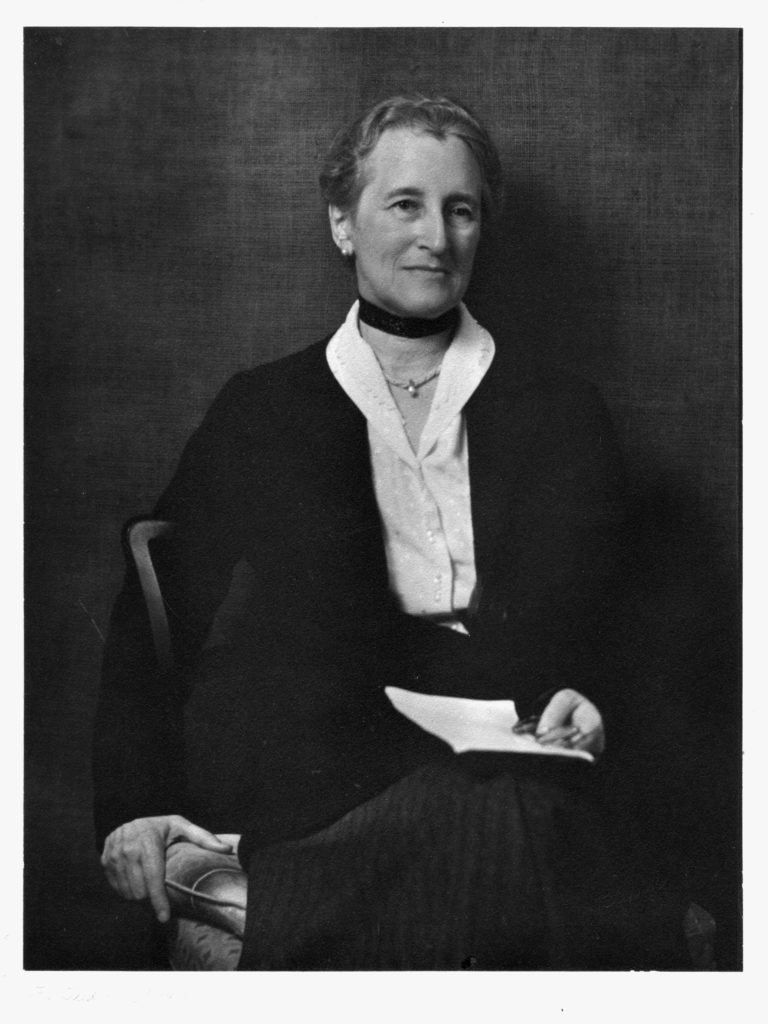
After reading this almost-poetic description of how to design and maintain a garden, I am struck by the immense amount of knowledge Beatrix Farrand must have had in her head and at her fingertips! She spent a long lifetime doing gorgeous work on the American landscape and she had every right to look regal and serious in her portraits. Brava!